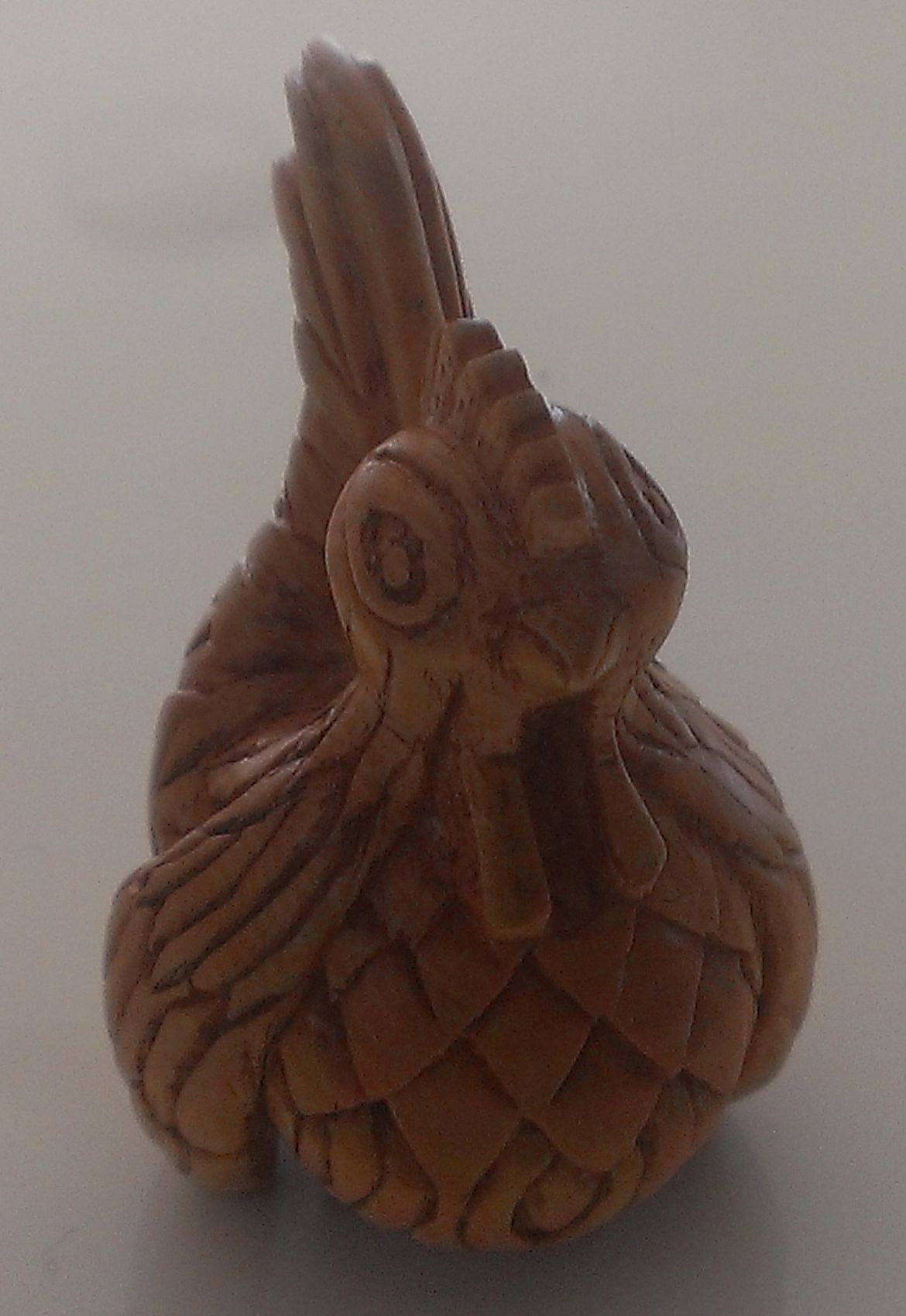
Well, we call them chooks here in Aus, although he is meant to be a rooster but ended up looking more like a homely hen. I drew up the pattern from various pictures of chickens found on the internet and fashioned him firstly from plasticene so I could visualise him from all angles. The carving is done from huon pine, and this piece was particulary hard and close grained,although often huon can be like butter to carve but you have to be careful as it is easy to catch the grain in the wrong direction where a chunk will lift or leave a very rough patch underneath. It will finish beautifully with a good sanding.
I spent a lot of time creating the feathered look and making sure the finish was clean. Because huon is a pale, yellowy wood I decided a bit of colour was necessary so I used tan shoe polish. Because shoe polish is wax based it gives a good finish whilst adding colour, with the cuts absorbing more polish and giving it highlights. It ended up with an extra coating as I inadvertently left it in my jeans pocket and it was well washed and a little paler after the experience, but it survived and was restored to its former glory. It measures about 25mm x 40mm (1″x1.5″)

 Woodchunks and Cotton Threads